1-year Team Project by -
Rajshekhar Dass / Abu Huraira Sheikh / Joji Abraham / Sunny Duseja
AWARDS
Winner of Michelin Challenge Design 2016 USA
Second Runner up of Launch Forth 2018 USA
Second Runner up of Pune Design Festival 2016 India
Finalist for RSA Student Design Awards 2016 UK
Project Snapshot
Timeline: 2014-2015
Role: Junior Designer
Collaboration: Michelin Design Challenge
Recognition: Winner of Michelin Challenge Design, Multiple Other Awards, Presented to the Indian Government & at design schools in France

Rural Innovation + Mobility + Connectivity
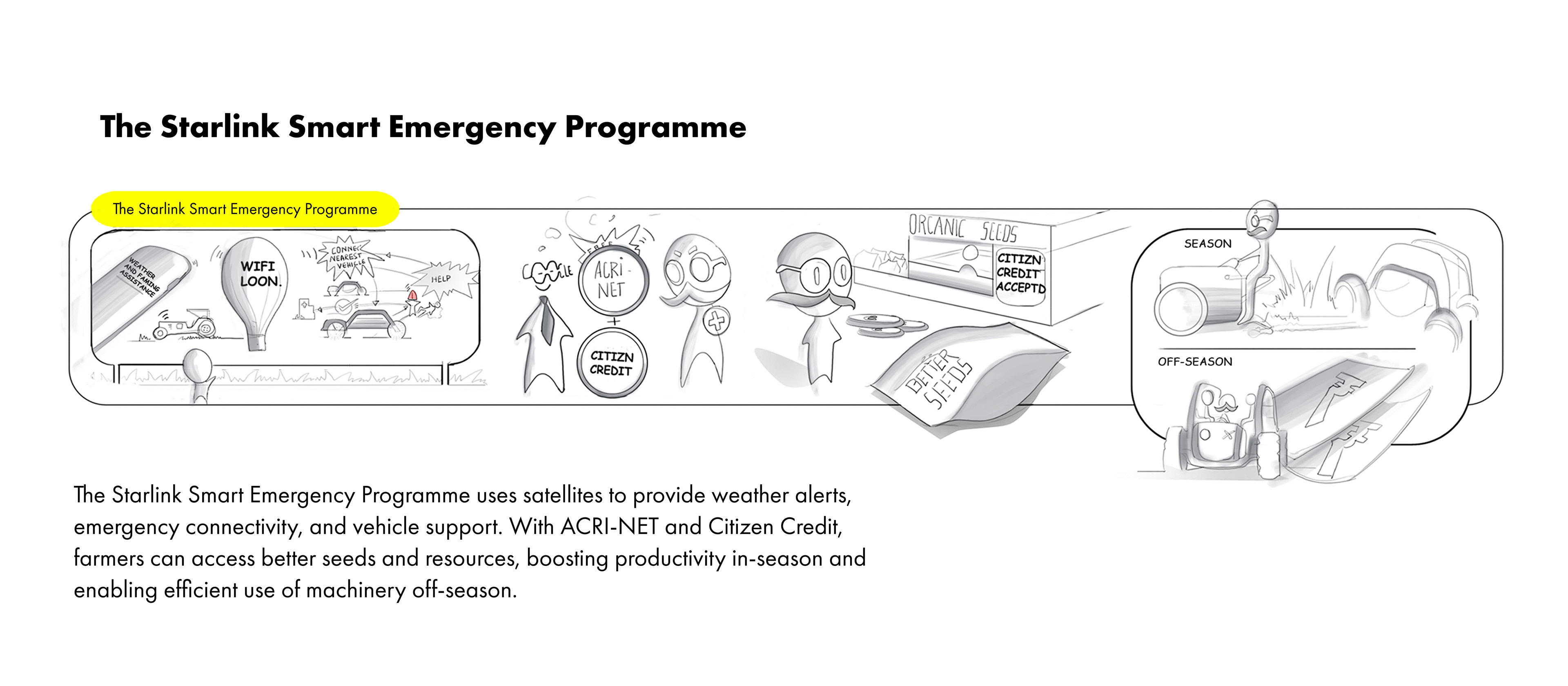
The vehicle assumes a pivotal role within the Starlink Rural initiative, dedicated to narrowing the digital gap and uplifting isolated communities. Integrated with Starlink Internet, it transforms into a central hub for delivering vital services to farmers, providing essential resources such as advanced farming techniques and real-time weather updates. As a token of appreciation for their active involvement, farmers are rewarded with credits that can be employed to acquire high-quality, subsidized seeds.
Expanding its technological capabilities, the vehicle engages in a strategic alliance with Tesla, contributing open-source technology to local manufacturers in India. This collaborative effort, in conjunction with the rural government, facilitates indigenous production, seamlessly weaving cutting-edge technology into the fabric of the community. Beyond symbolizing connectivity and agricultural innovation, the vehicle stands as a testament to the transformative power of public-private partnerships, nurturing a local ecosystem of innovation and fostering economic self-sufficiency.
In addition to its agricultural role, the vehicle serves a dual purpose by transitioning into a local people carrier during the off-season. This adaptable design ensures year-round utility, enhancing connectivity and facilitating transportation for community members. Specifically crafted to respond swiftly to emergencies in underserved regions, the vehicle becomes a lifeline for victims, providing crucial transportation to medical facilities. Whether engaged in farming activities, facilitating local transportation, or responding to emergencies, this versatile vehicle emerges as a symbol of community resilience and progress, fostering sustainable development in remote areas.


Solution
The CoV Community Vehicle was envisioned as a multi-functional modular mobility system designed specifically for rural communities. It could seamlessly transform into a community ambulance during emergencies, while also serving as a shared transport vehicle for people, goods, and farming activities in daily life. By combining healthcare access with everyday utility, the design ensures maximum value and impact for villages with limited resources.


Key Features:
Healthcare Mode: Quick conversion into an emergency ambulance.
Community Mode: Modular seats for farmers and villagers to transport goods and people.
Suspension-Inspired Chassis: Designed to handle rough rural roads during emergencies.
Afterlife Use: Frame can be repurposed post-vehicle life for community infrastructure (playgrounds, shelters, etc.).
Design Highlights
Modular Interiors: Adaptable for patient care or transport needs.
Z-Structure Layout: Efficient loading/unloading of stretchers or cargo.
Low-Cost Materials: Designed for affordability and easy local manufacturing.

What This Project Taught Me
Context is everything
Designing for rural communities demands a deep understanding of context, constraints, and lived realities especially in regions underserved by infrastructure.
Mobility can bring a difference
Mobility, when purpose-built, can be transformative not just in movement, but in delivering access to education, healthcare, and opportunity.
Design starts on the ground
On-ground research is invaluable, engaging directly with farmers and experiencing their environment firsthand shaped more empathetic, relevant, and grounded design decisions.
Thinking beyond the prototype
Real-world impact starts at the concept stage, designing with adaptability, multi-functionality, and scalability in mind sets the foundation for long-term relevance.
Design is powerful
Design is a powerful enabler of equity and it can bridge digital, social, and economic gaps when approached through a systems lens.


